
Tracing Back the Footsteps of the Marikina Shoe Industry's Rise and Fall
Follow the footsteps of the shoe industry from its humble beginnings to the industrialized city it is today.
WRITTEN BY WILLIANE TOBIAS

Share this article!
When one thinks of Marikina, its title of “Shoe Capital of the Philippines” always follows, but what else do we know about the shoemaking industry? By tracing back its footsteps, we see how shoemaking was an integral step in transforming Marikina from a farming village into an industrialized city we know today; and how the shoemaking industry went from holding monopoly over the production of shoes, to its decline in numbers in both sales and businesses.
The first step
Marikina was first a rural and fishing settlement. People would settle near river banks and in the valley. The industry’s early beginnings however can be traced back to 1887 when Don Laureano “Kapitan Moy” Guevarra, known as the father of Philippine shoemaking, dismantled a pair of worn British shoes. He studied the construction of the pair and replicated its design with the help of townsmen within his village. Through trial and error, this would establish the basis for the Marikina shoe industry.
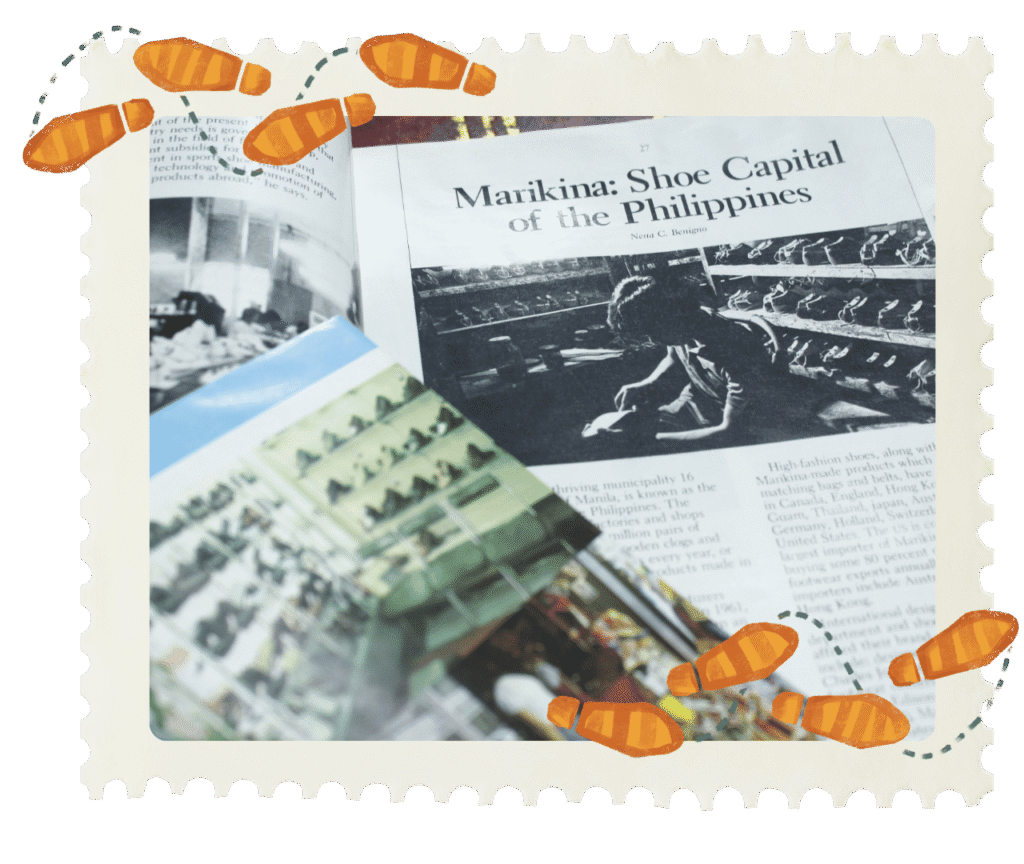
Through the years, Mariqueno residents developed a work ethic through their experience in shoemaking which prepared them for the rise of plants and factories mid 20th century. This ushered in a wave of new residents and workers within the city, with the industry quickly becoming a million peso industry. This in turn, gave birth to the moniker of “Shoe Capital of the Philippines”
Through the years, Mariqueño residents developed a work ethic through their experience in shoemaking which prepared them for the rise of plants and factories in the mid-20th century. This ushered in a wave of new residents and workers within the city, with the industry quickly becoming a million peso industry. People from nearby and far away provinces would settle in Marikina, setting up businesses and learning the craft of shoemaking. This in turn, gave birth to the moniker of “Shoe Capital of the Philippines.”

The peak of the journey
The peak of the industry from the late 60s to 80s was brought about by different factors. The Marikina shoe trade fair brought the craft to different parts of the country, even reaching Baguio city up north. The shoes were being sold at factory price, widening its reach to everyday Filipinos. Mayor Osmundo de Guzman, who led the Municipal Government at the time, placed importance on education within the industry. There were specialized courses in shoemaking and financial assistance given from the National Manpower and Youth Council and the Marikina Shoe Trade Commission. This paved the way for more skilled workers and experts.
Looking into the legislation surrounding local products and tariffs, it was a golden era of local production as international export was hard to come by with its high taxes. Under the Marcos presidency with its protectionist policies, Marikina held a monopoly over the shoe industry. This was a time where shoemaking provided 70% of the revenue that the local Marikina government received. Around this time, there were 2,000 registered firms making Marikina the biggest manufacturer of shoes in the country.
“He [Marcos] had this thing called import substitution industrialization. So if you had a product from abroad, but you can make it locally, you had incentives for that. And that was an ongoing theme from the 70s before. That’s what you call your protectionist policies,” Atty. Manjares mentioned when explaining the peak of the industry. Alongside this, he explained that the industry had steady contacts with the increasing demand for leather shoes within the Philippine military.
Two steps forward, three steps back
The downfall of the industry can be attributed to the General Agreement on Tariffs and Trade (GATT) in 1994 which lessened borders and taxes on international trade. Over time, the influx of cheaply produced shoes from China competed with locally produced shoes with their lower prices and production cost, as said by Sir Noel Box, OIC of MASIDO: “Yung mga product from China, kung ang comparison ng price. Siguro kung ₱ 100 sa atin,a China, mga between ₱ P30. Ang laki eh, ‘di ba?” (The products from China, when in comparison with our prices. If our price is ₱ 100, then for China its between ₱ 30. The difference is big, right?)
By tracing back the industry’s footsteps, we can see how Marikina succeeded in its peak. Now, we live in times different from our parents and grandparents. We can’t go back to how it was in the 60s with how globalized our country has become. With the noticeable decrease of registered firms and shoe businesses it seems as if the industry continues to decline until today, but not all hope is lost, as there are shoemakers who have adapted with the times, utilizing social media, alongside new shoe designers who breathe new life and ideas into the industry.
The Marikina shoemaking industry still stands to this day, and that’s no ordinary feat. In this continuing story–by walking the footsteps of the shoemaking industry, we know what its strengths are, and what can be improved upon.
Share this article!
SHARE YOUR THOUGHTS
How did you feel about the article? Join the discussion!